
100 Essential Vietnamese Words for Beginners
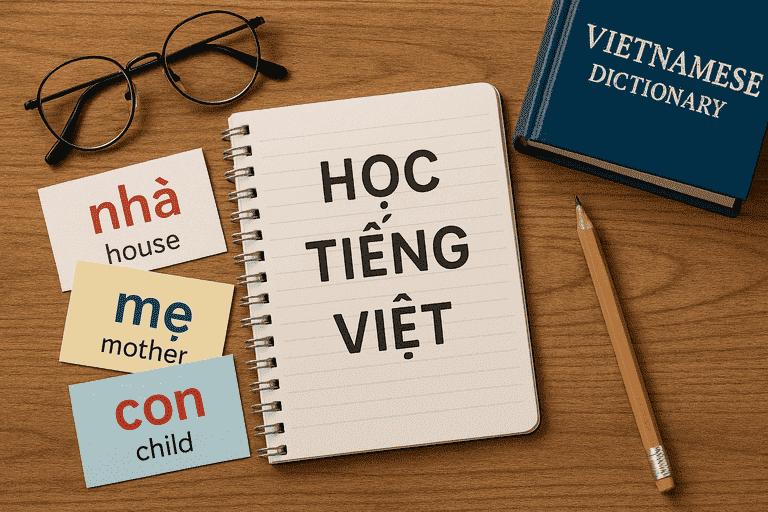
100 Essential Vietnamese Words for Beginners: Build Your Vocabulary the Smart Way
Learning your first 100 Vietnamese words is one of the most effective ways to start communicating with confidence. While Vietnamese pronunciation and tones may seem challenging in the beginning, building a practical vocabulary allows learners to understand everyday conversations and express simple ideas much sooner.
Many beginners make the mistake of memorizing long vocabulary lists without context. Unfortunately, isolated words are easy to forget. A better approach is to learn vocabulary by topic and immediately use new words in real-life situations. This not only improves memory but also develops natural communication skills.
1. Start with Everyday Vocabulary
Your first 100 words should come from situations you encounter every day. Instead of learning advanced or academic vocabulary, focus on words that help you introduce yourself, greet people, ask questions, and complete simple daily tasks.
Useful categories include:
Greetings and polite expressions
Family members
Numbers and time
Food and drinks
Colors
Daily activities
Transportation
Shopping
Weather
Common verbs and adjectives
For example, learning words like xin chào (hello), cảm ơn (thank you), nước (water), ăn (eat), đi (go), đẹp (beautiful), and bạn (friend/you) provides immediate value because they appear frequently in everyday conversations.
2. Learn Words in Context, Not Alone
Vocabulary becomes meaningful when it is connected to real communication. Instead of memorizing the word cà phê (coffee), learn the complete sentence:
"Cho tôi một ly cà phê, cảm ơn."
(I'd like a cup of coffee, thank you.)
This method trains your brain to remember vocabulary together with grammar, pronunciation, and natural sentence patterns.
Many online Vietnamese courses, including those at Hoang Thanh Dieu Language Center, organize vocabulary lessons around practical topics such as restaurants, transportation, shopping, travel, and workplace communication. This makes learning more enjoyable while helping students apply new words immediately.
3. Practice Every Day for Long-Term Success
Learning 100 words does not require hours of study each day. In fact, studying five to ten new words daily and reviewing previous vocabulary is often far more effective than trying to memorize dozens of words at once.
Flashcards, short conversations, listening exercises, and speaking practice all reinforce vocabulary naturally. Reading children's books, watching simple Vietnamese videos, or labeling household objects with Vietnamese names are also excellent ways to strengthen memory.
Most importantly, don't worry if you forget words occasionally. Vocabulary grows through repeated exposure, not perfect memorization. Every conversation, every sentence, and every review session helps transform passive vocabulary into active communication skills.
Your first 100 Vietnamese words are much more than a vocabulary list—they are the foundation of every future conversation. Once you build this foundation, learning longer sentences, understanding native speakers, and expressing your own ideas become significantly easier.
Language learning is a journey, and every new word is another step toward connecting with Vietnam's people, culture, and everyday life.